Friday, December 5, 2008

Silver Lining


In my life, I have never really had a constant object to keep near me as a security blanket - any objects I held in reverence have long since been tossed into the trash by my father without a second glance, along with many other valuable (memories-wise) items belonging to my brother and mom.

However, there is one item that sits, even now, on the topmost shelf of my dresser, that was gifted to me when I was thirteen, probably the worst age of my life. Around the neck of a tye-dyed purple Beanie Baby is a small, tarnished gold cross, it's white and red gems half-missing as it sits quietly surveying the bric-a-brac that clutters my room.

I don't remember exactly when it was given to me - I think it was right before Christmas Eve, immediately before my mom and I recieved our flu shots. That night, both my mother and I became ill, purportedly after-effects the flu shots, though my mother was the only one feeling better the next morning. I quickly became less and less willing to eat, and had little to no energy to move from our couch in the living room. By the time my father's Office Christmas Party rolled around, I was lethargic and could do little more than sleep all day. After a few hours, my mother called home to check on me, and immediately ran home, sensing something was wrong. The next morning, I was hauled out to the hospital, crying with the effort of walking, and was immediately admitted with pnemonia. As they prepared a room for me, I remember pulling the cross from my neck and handing it to my mother for safe-keeping. Somehow it ended back on my neck, where it stayed for the next seemingly endless week as I struggled to breathe and, at one point, completely stopped eating. My mother stayed with me the entire time, refusing to go home to sleep and literally holding me up as I was forced to walk around the halls to help my lungs. By the time I finally regained my appetite, half the gems in the cross were gone, having been worn out and off by my continued tossing and turning as I lay in the hospital.

As soon as I got home, the cross was taken off and disappeared for a long while - it wasn't until I moved back to Lincoln from Illinois with my mother and brother that I found it again, packed in with a going-away Beanie presented to me from one of my only true friends from the hell-hole of a Catholic school I'd attended in Illinois. I carefully wrapped the necklace around the Beanie's neck, and it has stayed there for the last almost six years, a constant reminder that no matter how hopeless and miserable I feel, there is always a way through - everything will be alright in the end, even if I have to endure a period of misery before the 'silver lining'.

Thanks, mom and Mary-Beth.

Wednesday, December 3, 2008

Only An Elephant

The first time I saw the small, ivory elephant - swaddled safely inside a clear, white film canister stuffed full off cotton balls - I nearly mistakened it for one of my teeth. Clutching the elephant tightly in my eager 5-year-old hands, I held it out to my mother, asking what it was.


As she held it up to the light, I was able to make out the small carvings of an eye, tusks, and trunk embedded in the ivory, the entire figure small enough to sit comfortable on the face of a dime.


When my great-great-grandmother was a young girl, her father took her to the circus, where she was terrified of the giant, powerful elephants parading around the ring. Shortly afterwards, her father came home with the ivory elephant, saying, 'See? Not so scary - it's only an elephant.'


After that day, the ivory elephant became a reminder to my great-great-grandmother to keep everything in perspective - never to let yourself be intimidated by a problem. Eventually, she handed the elephant down to my mother, who carried it faithfully to every one of her law exams to help her keep each situation and problem in perspective.


One day, I was told as the elephant was packed carefully back inside it's canister, I will inherit this small beacon, and until then, whenever I feel worried about some impending deadline or problem in my personal life, all I have to do is think back to that small, ivory carving waiting patiently in the back of my mother's closet and remember - it's only an elephant.

Tuesday, December 2, 2008

RhetResponse to 'Never Too Late'

The video for 'Never Too Late' by Three Days Grace relies heavily on pathos, compare/contrast and metaphor, while kicking logos completely out the window at times.

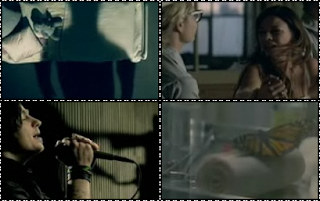
Compare/Contrast is used extensively throughout the video, flashing between peaceful scenes from the asylum ward's childhood and her chaotic life in the asylum. In the scenes featuring the inmate as a child, the audience is given a strong dose of pathos from the overly loving, cookie-cutter family she dances with in an ideal child's room, which serves to make the agony-ridden face and frantic efforts of the girl as an asylum ward, being physically torn away from her mother and bound to her bed to keep her from hurting herself or others.

Metaphor is also extremely prevalent in this video - the butterfly, a metaphor for freedom as it lands next to the girl, bound to her bed - the angel, possibly a personification of the mental retreat the girl forced herself into to escape the abusive nature of her father - the black handprints that appear all over the young girl and her bedroom walls, leading back to the father and acting as a physical representation of his abusiveness towards her - and the hands of the father than materialize in stead of the hospital restraints, representing both a physical and mental entrapment of the girl who has gone insane from a childhood of abuse.

This is also where logos gets almost drop-kicked out the window - much of the video's storyline plays out along the lines of Lewis Carrol's 'Alice in Wonderland', with the girl's memories changing to things that can't possibly be real or are highly unlikely, including the angel in the corner of her room, the parents with the band-aid eyes, the black hand-prints all over the girl and her room, and, at the end, when the girl apparently has been lying on a bed parallel to the floor or is walking straight up the wall from her bed.


Tuesday, November 25, 2008

'Never Too Late' for 'Three Days Grace'

((Embedding for this video has been disabled on every posting on YouTube, and Yahoo! is eating my entire post if I try to embed it from there (this is also why my posting is going up AFTER midnight, instead of when I finished and posted it AN HOUR AGO. Music video can be viewed HERE.))

As the video starts, a man dressed completely in black is shown playing the guitar. Behind him is a child's room, which starts to illuminate as the man starts singing and a child sits up on the bed. The girl gets up, moving closer to the singer, Adam Gontier, to join hands with her parents as each enters from the darkness beyond the walls of her room. The mother touches the girl's face lovingly as the father smiles and the parents and girl begin to dance around in a circle.


As the singer says 'never too late', the scene changes to a young woman being forcefully hauled through a sterile, hospital-like environment by two nurses. The singer momentarily reappears with the slightly sinister shadows of the young girl and her parents swirling visible on the wall behind him. The young woman turns back over her shoulder to look at another woman, the mother of the girl in the previous scene who is apparently grown and in an asylum, the same woman being hauled down the hallway. The older woman (the mother) is crying as she turns away from the daughter, who is pulled back along the hallway by the nurses. Darker scenes of the girl and her parents are shown behind members of the band and the singer as the music continues, before showing the daughter seemingly give in to the nurses and watch her mother go.


The scene again changes and the girl is back, with her mother and father slowly releasing her outstretched hands. The father reappears, sitting beside the girl and placing his hand against the front of her shoulder.


Anguished shots of the grown daughter's face are shown as she lies with her hair strewn around her, flashing back and forth between her grown self and herself as a child running to her bed and hiding underneath it. The flashback changes as the nurses begin to strap the daughter's wrists and feet to her bed, showing her mother and father with band-aids over their eyes as they dance with her in a circle. The shadow of her father is shown approaching her bed as her grown self struggles against her restraints, which have turned into her father's hands. Her memory then flashes back to her younger self still hiding under the bed, which is flipped over by her father to reveal her curled into a fetal position on the floor.


The scene changes again to show her younger self sitting with her father's hand still on her shoulder. She glances up at him before calmly leaving his frozen figure still seated as she approaches a number of mysteriously falling black feathers.


A monarch butterfly comes to sit on the bandages and pills next to the grown daughter as she lies strapped to her bed, and the flashback continues, showing the cause of the feathers to be a young man floating in the corner of her room, dresses completely in black and flapping two large, black wings that shed as they're flapped.


The butterfly leaves the medical table next to the now reasonably calm, grown daughter as she peers anxiously around herself, a flashback showing her sitting on her bed as a child, surrounded by black handprints all over herself, her furniture and her bed - the camera zooms out to show the paint-blackened hands of the father.


As the younger girl lies on her bed, her father and the black angel begin to fight, feathers falling as they push each other around the small room. As the feathers fall, they begin to collect around the younger girl, and also on the asylum bed around the girl, full grown. The fight between the angel and the father continues as the falling feathers increase in number and the grown girl begins to smile as her fathers hands/her restraints release her wrists and ankles. The grown girl curls into the fetal position on her hospital bed as the flashback of her father and angel fighting stops, with the father retreating. The grown girl climbs off her bed and begins to walk towards the camera, giving the impression of walking up her wall as a flashback of her younger self runs to her bed and climbs into it, her grown self smiling as she stops in front of the camera.


While I've seen this music video by Three Days Grace multiple times, I'd never really stopped to think about the storyline or the significance of said storyline in connection with the song, which is slightly ironic, considering it's one of the main things I love about this video - there's a complete storyline to go along with it.


I think the main reason that this video is so appealing to me - aside from the music - is because I was raised around a never-ending supply of horror and/or mystery movies, which allowed me a daily dose of craziness that has come to influence my own interests in movies, books, art, etc. The mystery surrounding why the young girl has come to be placed in an asylum, combined with the surreal (what I assume are) flashbacks that include fights with floating angels and band-aid-eyed parents (vaguely reminiscent of Coraline's 'Other Parents') serves to draw me in and hold my attention as I try to catch every flash of memories and scene changes between the daughter's past and present.


I also learned that every member of 'Three Days Grace' is from Toronto, Canada - where I'm from. How cool is that?

Monday, November 17, 2008

''Staring Contest" - Final Draft

((Click the image to enlarge))


In cultures all over the world, death - both the occurrence and the personification of it - is most commonly viewed as a horrific reality that will eventually claim every living soul on Earth - something to be deeply feared and avoided at all costs. Soemthing that cruelly tears families, friends and loved ones apart against the well-meaning human wishes of the living that often, unfortunately, merely extend the agony and suffering of the dying by trying to hold on said loved one's life with the use of advanced technology that only serves to prolong the inevitable for only a short period of time. Rarely do the living stop to think about the comfort that Death can also bring; such as release from a painful, all-consuming mental or physical disease, or from the crippling after-effects of a cruel accident that leaves it's victims in constant pain and unable to physically care for themselves or even function properly at all, mentally or physically. Possibly the most suprising un-realized 'gift' of Death is the reunion of loved ones with their own loved ones who had already 'shuffled off this mortal coil' long before they did themselves.

Yet, in this warring world where families are so often torn violently apart by death, "Staring Contest" by Cyril Van Der Haegen still dares to show the lighter, more innocent side to an anthropomorphic figure who is more commonly associated with painful, despairing and anguished circumstances than peaceful and unifying ones, such as those mentioned in the previous paragraph.


In "Staring Contest", a balanced blend of rapport, comparisons and constrasts, analogy and humor are all used to convey the apparent message that Death is not necessarily always such a horrific and painful event as many people tend to make it out to be. By introducing the small, innocent (and, quite probably, warm and fuzzy) rabbit into what would otherwise be considered a bleak scene of death and cold, Van Der Haegen creates an illustration of a more peaceful encounter with Death, bringing a sense of comfort and friendliness into the piece - as well as the viewer - as they take in the humorous scene of the personification of Death engaging in a staring contest with a young rabbit.

As you examine the picture, you may begin to notice the recurring theme and patterns of swirls and circles used throughout the image, such as in the shape of the pendant around Death's neck or in the design embedded in the wide base of Death's scythe. It can also be found imprinted in the snow at Death's feet, and in the curving of the branches of the trees in the background or in the folds of Death's cloak.


These swirls could possibly stand as a metaphor, here meant to represent the 'mortal coil', as William Shakespeare first termed it, and serving as a reminder that Death always comes full-circle - no exceptions -, only separating loved ones for a time - everyone will die eventually, and, depending on your religious standpoint, we will all be reunited with those loved ones we have lost when Death comes full circle to ourselves, an idea that is most likely to be considered a comforting thought to the majority of us. The background of the piece itself is also very soothing to the senses, in contrast with the not-so-lively image of Death. The backdrop of this stare-off is done in multiple shades of white, a color which commonly represents innocence and purity, helping to add to the growing feeling that maybe Death is not always meant to be viewed as a horrific event, as it is often made out to be.


The white of the background also helps to convey a sense of peace in contrast to Death's bleak appearance and profession. As mentioned previously, white is commonly respected as the color of innocence, and the almost overwhelming presence of white in this piece introduces a softer touch to the scene than, for example, the use of bold reds and blacks would have done. These colors, in contrast to the clean, soft white present in this scene, could serve to heighten the anxiety felt by the viewer as they gaze on Death and perhaps cause this scene to be viewed as more of a stand-off between Death and the rabbit than a friendly game of 'Who-Can-Make-Their-Eyes-Fall-Out-First'. In using white, the artist presents us with a more peaceful scenario of mortality vs. fatality and instills a more childlike quality in the scene, by using both a peacefully-colored background and in portraying both Death and the rabbit as engaged in a childlike game - only in this case, whoever blinks first could possibly stand to lose not only the game, but their soul.


Another aspect of this painting that helps to create a sense of life and happiness is easily overlooked at first - as Death stands challenging/challenged by the rabbit, brightly colored leaves swirl around Death's cloak in a way slightly nostalgic to 'Pocahontas', (but we won't go there). These leaves, a possible anaology for life and exuberence in an otherwise dreary circumstance, greatly brighten the wary and bleak surroundings of the competitors while also creating a sense of warmth. The presence of these lively-colored leaves, in comparison with the small, innocent rabbit, helps to create an even more greatly lessened sense of fear and hostility in this relativaly bleak scene of an encounter with Death.

On the other hand, these leaves could also stand to be viewed as a metaphor for unhappy souls claimed by Death - no longer suffering from their previous mortal wounds, fears or illnesses, these souls, here represented by multiple brightly-colored leaves, are vibrant and peaceful as they swirl energetically alongside a sort of heroic figure who has freed them from their pain.

In the end, Death is still likely to be more often viewed as a menacing figure - a symbol for all that will eventually come to a close. But, thanks to Van Der Haegan's uncommon, light-hearted illustration, perhaps we can now believe that Death is not something to be so feared at all, but see it as a bringer of peace, instead.